
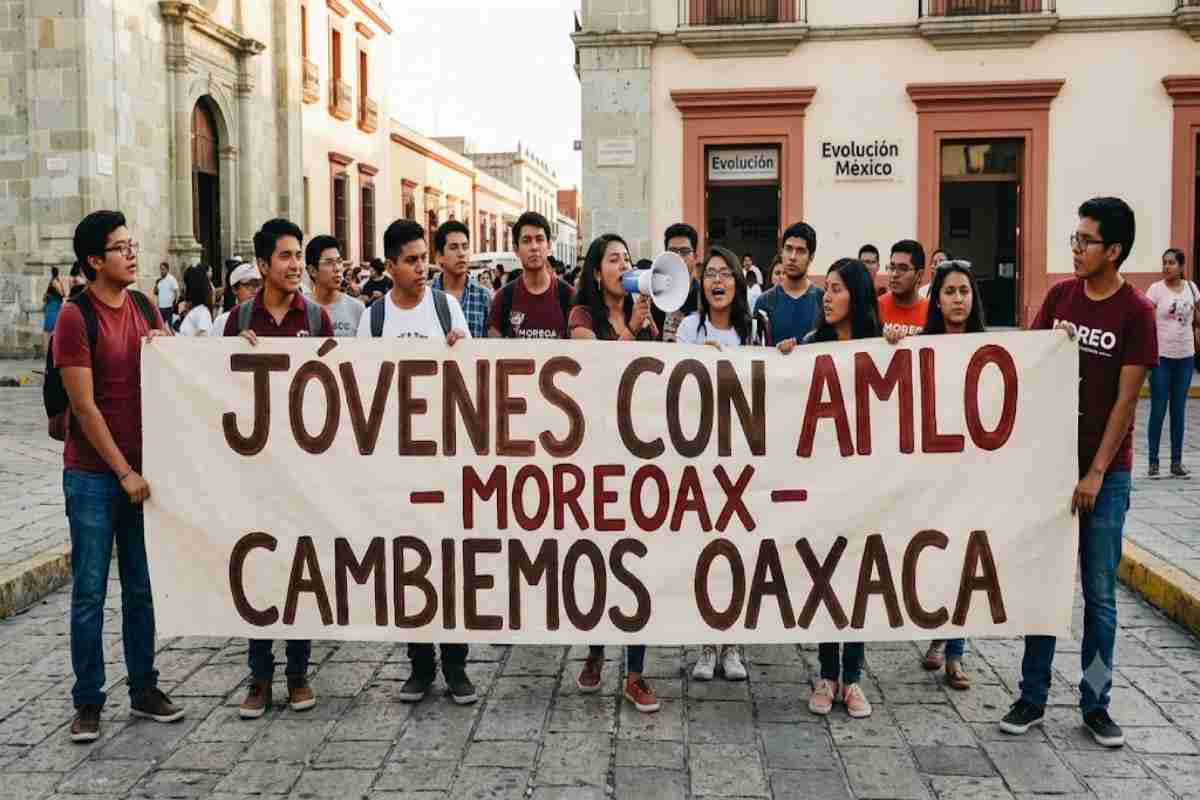
The phrase “https://costumbresmexico.com/se-presentan-jovenes-proamlo” refers to a news report published in April 2020 by Evolución México, although the event described relates to the political context of 2018 and youth support for Andrés Manuel López Obrador. The article states that members of the Movimiento Regional de Oaxaca (MOREOAX) publicly introduced themselves as a new organisation and expressed their support for the then-presidential candidate.
Beyond the specific announcement, the episode is interesting because it reflects a broader issue in Mexican politics: the effort by youth organisations to turn dissatisfaction with problems such as employment and limited opportunities into organised political participation.
What Does “https://costumbresmexico.com/se-presentan-jovenes-proamlo” Mean?
The phrase “https://costumbresmexico.com/se-presentan-jovenes-proamlo” can be understood as the public announcement of a group of young people who declared their support for López Obrador and introduced a regional political organisation in Oaxaca.
According to the original publication, members of MOREOAX held a press conference to present the movement. The young members stated that they would work in an organised manner and had statutes establishing the internal rules of their group.
The announcement had two dimensions:
| Element | What it represented |
|---|---|
| Youth organisation | An attempt to structure youth political participation |
| MOREOAX | The Movimiento Regional de Oaxaca mentioned in the publication |
| Support for AMLO | A political position supporting López Obrador |
| Employment concerns | The group connected its message with the lack of employment |
| Political change | The members said they supported change for Oaxaca and Mexico |
The importance of the episode, therefore, is not simply the group’s support for a candidate. It also demonstrates how some young people sought to participate in political discussions through their own organisations.
Who Were the Young Members of MOREOAX?
The original article identifies the group as the Movimiento Regional de Oaxaca (MOREOAX). The publication explains that the organisation presented itself publicly in the state and intended to mobilise young people.
However, there is an important limitation for any current analysis: the original source provides relatively little information about the organisation’s structure, number of members, leadership or subsequent development.
For that reason, it would not be accurate to describe the movement as a national organisation or claim that it represented all young people in Oaxaca.
An Important Point About the Sources
The original publication is dated 11 April 2020, but its content discusses López Obrador as a presidential candidate and describes the group’s support in that political context.
This makes it necessary to distinguish between:
- The date when the webpage was published.
- The political context described in the report.
Confusing these two elements could make it appear that the announcement occurred during López Obrador’s presidency, when the text clearly refers to the context of his presidential candidacy.
Why Did Young People Support AMLO?
The original article provides an explanation from members of the movement themselves. They referred to employment-related problems and argued that young people were not receiving sufficient support. They also stated that they wanted to promote, together with López Obrador, a change for Oaxaca and the country. This argument needs to be understood within the political environment preceding the 2018 election.
Young people were an important electoral segment. According to Mexico’s National Electoral Institute (INE), people between 18 and 29 years old represented approximately 29% of the potential electorate in the 2018 elections. This helps explain why young people became an especially important group for presidential campaigns.
Youth Participation in the 2018 Elections
Youth participation was not uniform. INE data show that young voters had lower participation rates than some older age groups.
At the national level, the INE’s study of the 2018 federal elections found that people aged 20 to 30 recorded an average participation rate of 52.8%, compared with approximately 60% for the overall average.
In Oaxaca, there were also significant differences depending on age and gender.
| Group | Approximate participation in Oaxaca, 2018 |
|---|---|
| Women aged 18 | 70.9% |
| Men aged 18 | 67.2% |
| Women aged 20–24 | 62.0% |
| Men aged 20–24 | 57.5% |
| Women aged 25–29 | 61.2% |
| Men aged 25–29 | 48.2% |
| Women aged 30–34 | 68.8% |
| Men aged 30–34 | 56.2% |
These figures come from the INE’s sample study of citizen participation in the 2018 federal elections.
The conclusion is important: being young did not automatically mean being politically disengaged, but there were considerable differences within the youth population itself.
The Role of Employment in the Youth Political Message
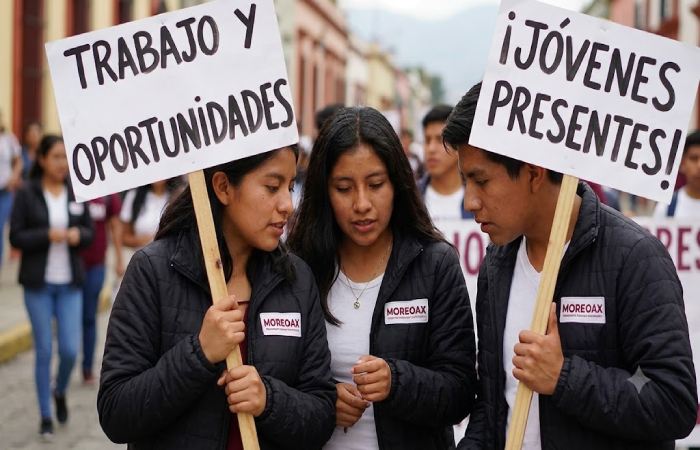
One of the central elements of the MOREOAX announcement was employment. Members quoted in the original publication connected their political support with the perception that young people lacked sufficient support and employment opportunities.
This issue was not isolated from Oaxaca’s wider political debate.
Years earlier, state representatives had already raised concerns related to education and youth employment. In 2011, a local legislator discussed challenges surrounding university access and employment opportunities for young people.
This helps place the MOREOAX message into context: demands related to employment, education and youth political representation were already part of public discussions in Oaxaca before 2018.
Young People and Political Representation in Oaxaca
Youth participation was not limited to voting.
Oaxaca had already seen discussions about how to increase youth representation within political institutions. Proposals during the 2010s included mechanisms that would encourage political parties to include a percentage of young candidates on their lists.
There were also arguments that young people represented a significant share of the state’s population and electorate.
From this perspective, the emergence of organisations such as MOREOAX can be viewed as part of a broader trend: young people were not only seeking recognition as voters, but also greater participation within political structures.
Did MOREOAX Represent All Young People in Oaxaca?
There is insufficient evidence in the original source to claim that MOREOAX represented all young people in Oaxaca.
This distinction is essential.
An organisation can bring together young people who share a political position without statistically representing the entire youth population of a state. In fact, INE electoral data demonstrate that youth political behaviour varies considerably according to age, gender and other factors.
Therefore, it is more accurate to describe MOREOAX as a youth group that publicly expressed support for López Obrador, rather than saying that “the youth of Oaxaca supported AMLO.”
What Was the Relationship Between the Movement and AMLO?
According to the original source, members of MOREOAX said that they were promoting, together with Andrés Manuel López Obrador, the change they believed Oaxaca and Mexico needed.
The key word here is support. The publication documents a favourable political position, but it does not provide enough information to establish that MOREOAX had a formal institutional relationship with the presidential candidate.
Therefore, later content should avoid automatically describing the organisation as an official campaign structure without additional documentation.
The Political Context of 2018
Youth support for López Obrador needs to be understood within a presidential election in which young voters represented a substantial electoral segment.
Polling conducted during the campaign also showed López Obrador performing strongly among younger voters. A 2018 Mitofsky poll, for example, reported a 41.7% preference for López Obrador among people aged 18 to 29 within the sample analysed.
However, electoral preference and actual participation are two different phenomena.
A young person could support a candidate but still choose not to vote. This is why electoral studies distinguish between political identification, voting intention and actual electoral participation.
Why Does This Episode Still Matter?
The story behind “https://costumbresmexico.com/se-presentan-jovenes-proamlo” provides a small window into a much larger phenomenon: the involvement of young people in organisations and movements connected with the 2018 election.
There are three key lessons:
| Lesson | Importance |
|---|---|
| Young people were an important electoral bloc | They represented a substantial share of the potential electorate |
| Youth participation was uneven | Voting rates differed considerably by age and gender |
| Participation went beyond voting | Young people also sought involvement in political organisations |
The episode also demonstrates why local political news needs to be examined in context. A press conference involving a relatively small youth organisation may appear to be a minor event, but it becomes more significant when viewed within a national electoral process.
Frequently Asked Questions
What does “https://costumbresmexico.com/se-presentan-jovenes-proamlo” mean?
It is the title of a publication from Evolución México describing the public presentation of MOREOAX members, who expressed their support for Andrés Manuel López Obrador.
What was MOREOAX?
The publication identifies MOREOAX as the Movimiento Regional de Oaxaca, an organisation that publicly presented itself and said it wanted to mobilise young people.
Did MOREOAX represent all young people in Oaxaca?
There is not enough information in the original source to make that claim. What is documented is that a group of young people presented themselves as an organisation and expressed support for López Obrador.
What role did young people play in the 2018 elections?
Young people were an important electoral group. The INE estimated that people aged 18 to 29 represented around 29% of potential voters, although participation rates were lower among several younger groups.
Was youth support for AMLO purely electoral?
Not necessarily. The MOREOAX case demonstrates one form of organised participation, while other young people participated through voting, social organisations, political discussions and community activities.
Conclusion
“Https://costumbresmexico.com/se-presentan-jovenes-proamlo” should not be understood simply as the announcement of a political group. The episode reflects a period when youth participation, employment, representation and social opportunities were important parts of the political conversation in Oaxaca and Mexico.
Ultimately, the MOREOAX case illustrates an issue that remains relevant to Mexican politics: young people can be an important electoral group, but their lasting political influence depends on how effectively they transform social concerns into organised and sustained participation.