
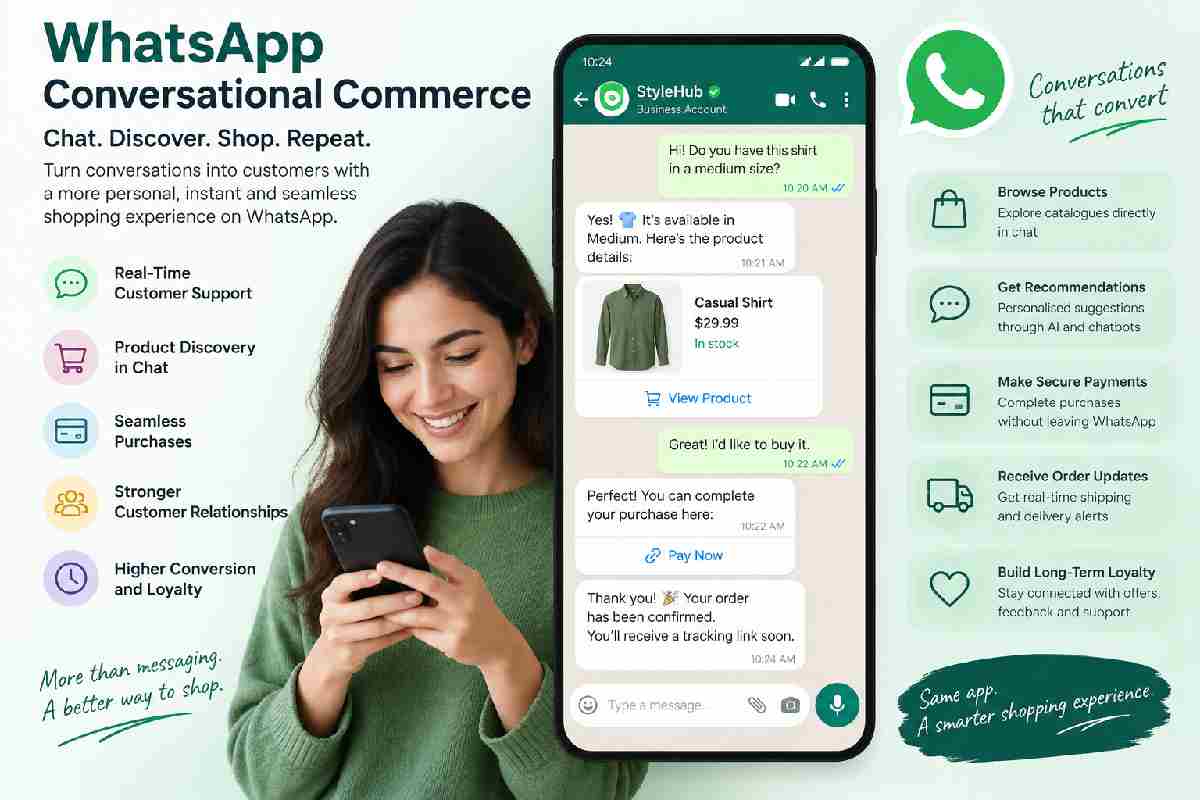
Most go-to-market playbooks start from the same assumptions. You need a website that converts, an app that retains, a checkout that removes friction and a paid acquisition engine feeding the top of the funnel.
India’s online cricket ID market grew into a large, crowded category while ignoring nearly all of that. There is no app to download from an official store. The major ad platforms have restricted the category for years. There is rarely a checkout page. The whole customer journey, from discovery and onboarding to verification, payment, support and retention, happens inside a WhatsApp chat.
I have spent more than a decade working on go-to-market for gaming and SaaS products, and I think this market is one of the clearest real-world examples of conversational commerce at scale. It is worth studying not because other businesses should copy it, but because it shows what happens when the usual channels are closed and a market has to find another route to its customers.
The Market in One Paragraph
An online cricket ID is a login to a betting exchange platform, issued by a third-party provider rather than opened directly with the platform. Providers handle account creation, identity checks, local payment rails and customer support, usually in more than one language. A user picks a provider, sends a message, gets verified and receives login credentials. A large number of providers compete for the same users, often offering access to the same handful of exchanges. Product differentiation is thin. Service differentiation is almost everything.
It is also a category shaped heavily by regulation, and India’s rules on real-money online gaming have changed significantly, which is one more reason its channel choices look so unlike a typical consumer business. This piece looks only at the go-to-market mechanics.
Constraint One: The Channels That Were Closed
Start with what was unavailable. App store policies on real-money gaming are strict and vary from country to country. Search and social ad policies restrict the category heavily. Payment gateways are cautious. Mainstream media is largely off-limits.
Remove paid search, paid social, app store discovery and a conventional checkout, and the list of remaining options gets short very quickly: organic search, referrals, communities and direct messaging.
That constraint ended up working as a design brief. When you cannot send people to your app, you meet them inside the app they already have open all day.
Trust Is the Product
In most consumer categories, trust is built by the brand and the product experience long before a customer speaks to a human. Here the order is reversed. The first real product interaction is a conversation.
A new user’s worries are specific and immediate. Is this provider real? Will my deposit arrive? Will I be able to withdraw? A landing page can make claims about all of that, but a person replying within a minute, in the user’s own language, answering the exact question that was asked, is more persuasive than any trust badge.
This is the insight that travels furthest. When purchase anxiety is high and the product is hard to judge in advance, a quick, human, two-way conversation often beats a polished self-serve flow. Enterprise software has always known this, which is why it employs sales engineers. The cricket ID market applied the same logic to a mass consumer audience and used WhatsApp as the channel.
Look at how a provider such as cricketonlineid.com structures its website. Almost every section, from the explainers to the FAQs, leads to the same action: start a WhatsApp conversation. The website is not really the storefront. It is pre-sales material, there to make someone comfortable enough to send that first message.
Language as a Growth Lever
The second lever is language. A large part of the audience is more comfortable in Hindi, in Hinglish or in a regional language than in formal English.
Self-serve onboarding is expensive to localise properly. Every screen, error message and help article needs translating and testing. A chat-based model localises almost for free: you hire support staff who speak the language, and the conversation adapts on its own. A user can switch from English to Hindi halfway through a sentence and nothing breaks.
Content follows the same pattern. Hindi and Hinglish explainers meet a demand that search results historically served mostly through video. For a GTM team, the lesson is that localisation does not always mean translating the product. Sometimes it means placing a person who speaks the language between the product and the user.
What the Funnel Actually Looks Like
Mapped out, the journey is short, but every stage does real work.
Discovery. Mostly organic: search results for explainer content, referrals from existing users and word of mouth in group chats. Paid acquisition plays a far smaller role than in most consumer categories.
First message. Earning this is the website’s whole job. A pre-filled WhatsApp message reduces the effort to a single tap, and the first human reply sets the tone for everything that follows.
Qualification. Within a few messages, the support agent works out what the user actually wants: which platform, what kind of account, and whether they are new to exchanges. In a conventional funnel, that would be several form fields and a drop-off at each one.
Verification and payment. Identity checks and the first deposit happen in the same thread, with the agent explaining each step as it arrives.
Activation. Login credentials are delivered in the chat. The user is live within minutes, and the thread stays open.
Retention. Every later question, withdrawal request or complaint goes back into that same conversation. The support channel and the retention channel are one and the same.
The Agent Network: Distribution Built Into the Product
The most interesting structural feature of this market is its hierarchy. Exchange platforms do not only issue individual player accounts. They also issue master-level accounts that can create and manage player accounts beneath them, and the structure can run several layers deep.
In practice this is an affiliate and reseller programme built directly into the product. A master account holder recruits and supports their own users, handles their payments and earns from their activity. Look closely at how user and master IDs are structured and it resembles a channel-partner programme in B2B software far more than a consumer app.
The go-to-market consequences are significant:
- Acquisition is decentralised. Growth comes from many small operators, each working their own network.
- Support scales with distribution. Each new layer brings its own support capacity.
- Incentives are aligned locally. The person who acquires a user is also the person who has to keep that user happy.
- Quality control is hard. User experience and user protection depend on the weakest operator in the chain, which is exactly where most of the market’s trust problems begin.
That last point deserves attention. Decentralised distribution grows quickly, but it hands your reputation to people you do not directly manage.
Why Apps Lost This Market
It is tempting to assume that a slick mobile app would beat a WhatsApp chat. In this market, apps ran into problems that chat simply did not have.
Distribution. Without an app store listing, an app has to be sideloaded as an APK file, which asks users to click past security warnings before the product has done anything at all. That is a large trust hurdle at the worst possible moment.
Maintenance. Sideloaded apps are harder to update and easier to break.
Onboarding cost. Download, install, register, verify, deposit. Every step loses users. A chat collapses all of it into one thread.
Relationship. An app is a tool. A WhatsApp contact is a relationship that sits in the same inbox as family and friends, and it is there the moment the user wants to come back.
None of this means apps are worse in general. It means the channel should follow the constraints, and here the constraints pointed firmly towards messaging.
Where the WhatsApp Model Breaks
Conversational commerce is not free, and this market shows its limits more clearly than most.
Platform dependency. The whole business runs on a channel the business does not own. Numbers get reported and banned, and a banned number can mean losing every customer relationship attached to it. Serious operators keep backup numbers and ways to re-verify existing customers, but the risk never goes away.
Impersonation. If your brand lives in a chat, anyone can create a chat that looks like your brand. Cloned numbers are a constant problem, and they damage honest operators as much as they harm users.
Scale economics. Human conversations cost money. When response time is the product, staffing has to track demand, including the sharp spikes around big matches.
Measurement. Attribution in a chat-first funnel is messy. Knowing which article, referral or campaign produced a conversation takes discipline: tagged links, a source question in the first reply and consistent record-keeping.
Compliance exposure. A loosely structured channel makes it harder to show consistent processes for verification, record-keeping and user protection. In a closely regulated category, that is a strategic risk rather than an operational detail.
Lessons for SaaS and D2C Teams
Most people reading this do not work in gaming, and nobody should try to imitate a market operating under constraints this unusual. Several of its lessons, though, travel well.
Match the channel to the anxiety. If buyers are nervous, get them to a human quickly. A chat option on high-consideration pages can outperform yet another round of landing-page tests.
Let content do the pre-sales work. Educational content that answers real objections, such as how it works, what it costs and what can go wrong, turns cold visitors into warm conversations.
Localise the conversation before the product. Multilingual support staff can open a new market long before a fully translated product is ready.
Treat partners as part of the product. If resellers or affiliates carry your name, their behaviour is your customer experience. Invest in training them and in ways for customers to verify them.
Own a fallback. If one platform can switch off your customer relationships, build a way to reach customers that does not depend on it, whether that is email, SMS or a verified list of official contact details on your own domain.
Publish your official channels. One of the simplest defences against impersonation is a clearly listed official number or handle on your own website, so customers can check before they trust.
The Bigger Picture
The cricket ID market is an extreme case: intense regulatory attention, closed ad channels, high purchase anxiety and a mobile-first audience that lives inside WhatsApp. Extreme cases are useful precisely because they make trade-offs easy to see.
It shows that a funnel can be rebuilt around a conversation, that trust can be earned in real time rather than designed into a page, and that distribution can be written into a product’s structure. It also shows the cost: dependence on a platform you do not control, and a reputation spread across operators you cannot fully supervise.
For most businesses, the right answer sits somewhere between the two. Keep the self-serve flow for people who want it. Add a fast human conversation for people who need one. And make it very easy for customers to tell the real you from the imitation.