
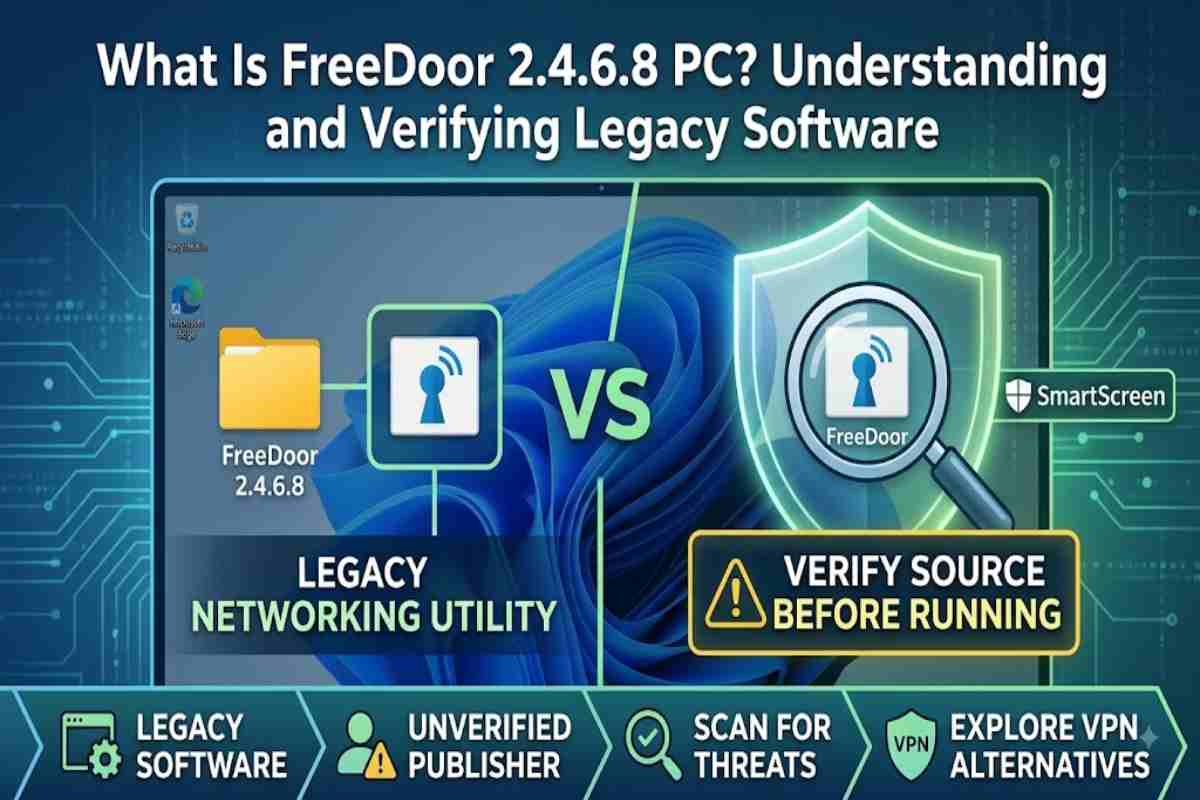
FreeDoor2.4.6.8 PC is a version of the FreeDoor network utility commonly described online as a lightweight proxy or anti-censorship tool. Information about this exact release is inconsistent across third-party sources, so users should verify the publisher, file integrity, and software provenance before running an executable.
Freedoor2.4.6.8 pc refers most likely to an old release of the FreeDoor project, which is documented as working as a route network through a proxy-based solution alongside the DynaWeb project. In some mentions, this is a portable Windows program; other entries provide contradictory information concerning compatible operating systems, installation steps, and even the overall nature of the software.
That inconsistency is important. Rather than treating every download page as authoritative, users should first establish exactly what file they have, where it came from and whether Windows security tools consider it trustworthy.
What Is FreeDoor2.4.6.8 PC?
FreeDoor is described as a network access utility, capable of sending a browser’s traffic via proxy systems. Its online references also link to Dynamic Internet Technology, DynaWeb, although firm documentation for its 2.4.6.8 version can be hard to locate.
Several unofficial guides refer to it as a portable Windows executable which could be decompressed and used without a standard installation wizard. FreeDoor2.4.6.8 PC would therefore seem more appropriately categorized as legacy or poorly maintained software than as contemporary mainstream networking software.
Key Features Reported Online
The following characteristics are commonly attributed to this version:
| Feature | What users may encounter |
|---|---|
| Portable operation | Some sources describe running it directly from an extracted folder |
| Proxy routing | Traffic may be routed through intermediary servers |
| Lightweight design | Reported to require relatively few system resources |
| Automatic connection | Some guides describe automatic server selection |
| Windows support | Third-party sources report compatibility with several Windows versions |
| Browser configuration | Local proxy configuration may be required in some setups |
These are reported characteristics, not independently verified specifications. Different websites provide contradictory information, so readers should not treat a third-party system-requirements table as an official specification sheet.
Freedoor2.4.6.8 PC: System Requirements
There does not appear to be a sufficiently authoritative current specification sheet for this exact build. Third-party documentation has variously suggested very modest requirements, including older Windows versions, low RAM usage and minimal storage requirements.
A practical compatibility checklist is therefore more useful:
| Requirement | Practical guidance |
|---|---|
| Operating system | Check the exact release documentation before running it |
| RAM | Modern Windows PCs should have ample memory for a lightweight utility |
| Storage | Keep additional free space for extraction and security scans |
| Internet | Required for proxy/network communication |
| Security | Keep Microsoft Defender or another reputable security solution enabled |
| Permissions | Do not grant administrator access unless genuinely required |
How the Basic Workflow Works
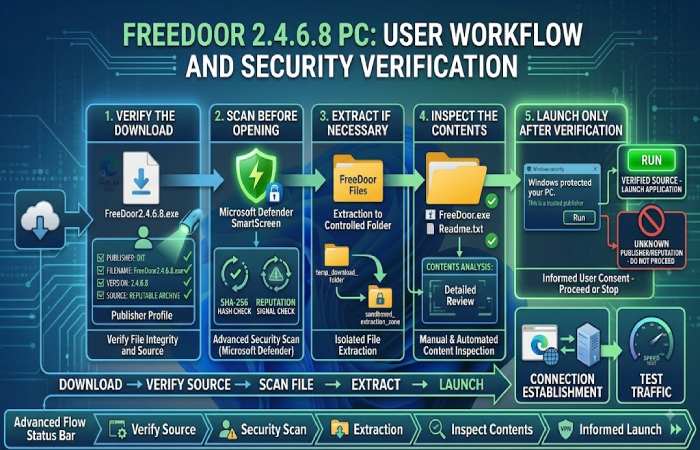
FreeDoor-style proxy utilities typically sit between the browser and the destination website.
Basic workflow:
Download → Verify source → Scan file → Extract → Launch → Establish connection → Test browser traffic
The important step is not launching the executable; it is verification before execution.
Step 1: Verify the Download
Check the publisher, filename, version and download location. Be particularly cautious with websites that provide several renamed versions of the same executable.
Step 2: Scan Before Opening
Scan the downloaded archive or executable with your security software. Microsoft Defender SmartScreen evaluates downloaded files using reputation signals such as publisher information and file-hash reputation.
Step 3: Extract If Necessary
If the file arrives as a ZIP archive, extract it to a dedicated folder rather than running unknown files directly from the archive.
Step 4: Inspect the Contents
Look for unexpected executables, scripts, browser extensions or bundled installers. An archive containing unrelated software is a warning sign.
Step 5: Launch Only After Verification
Run the application only when you are comfortable with its provenance. If Windows produces a security warning, do not automatically bypass it.
Performance Expectations
A proxy connection should not automatically be expected to improve internet speed.
Routing traffic through an intermediary can introduce additional latency. Actual performance depends on:
- distance to the proxy server;
- server congestion;
- your existing connection;
- the destination website;
- routing quality; and
- whether the proxy handles all or only selected traffic.
For ordinary browsing, a user might notice slower page loading compared with a direct connection. Claims of guaranteed speed increases should therefore be treated sceptically.
Pros and Limitations
| Potential advantages | Limitations |
|---|---|
| Lightweight design reported by third-party sources | Documentation is difficult to verify |
| Potentially simple proxy workflow | Proxy routing can reduce performance |
| May work on older hardware | Legacy software can have compatibility issues |
| Portable operation may be convenient | Unknown downloads can create security risks |
| Useful for understanding proxy concepts | Not equivalent to a modern security-focused VPN |
Is FreeDoor2.4.6.8 PC Legitimate?
This is the most important question for anyone searching for the software.
The existence of webpages describing FreeDoor 2.4.6.8 does not by itself prove that a particular download is authentic. Search results contain conflicting descriptions, including pages that call it a proxy utility and others that describe entirely different technical functions.
Therefore, do not assume that every file labelled FreeDoor2.4.6.8.exe is genuine.
A safer approach is to verify:
- Publisher identity.
- Original download source.
- Digital signature, where available.
- SHA-256 checksum, where an authoritative checksum exists.
- Antivirus results.
- File behaviour in a controlled environment.
Microsoft also explains that an unfamiliar SmartScreen reputation warning does not automatically prove malware, but it is a reason to exercise caution and verify the source before proceeding.
Who Should Use It?
FreeDoor2.4.6.8 is mainly relevant to technically confident users researching legacy proxy software, historical networking tools or compatibility with an older environment.
It is not an obvious choice for everyday users who simply want secure modern browsing.
Who Should Avoid It?
Avoid unknown builds if you:
- need dependable modern security features;
- plan to use online banking;
- handle confidential business information;
- cannot verify the source of the executable;
- are unfamiliar with proxy configuration;
- are using a work or school computer without administrator approval.
A legacy proxy should never be assumed to provide the same protection as a modern, professionally maintained security product.
FreeDoor vs Modern Alternatives
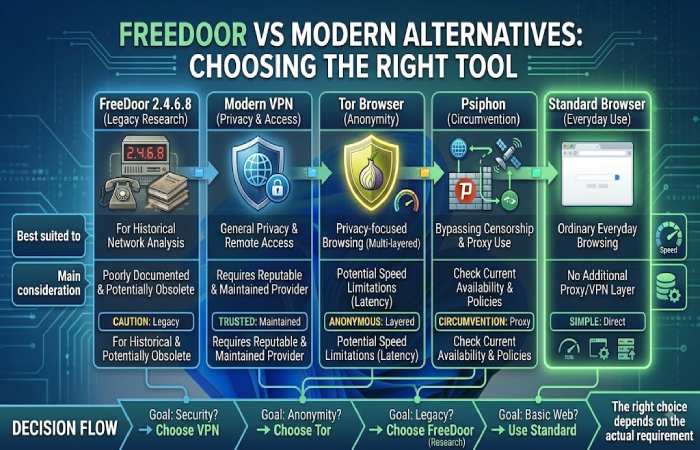
| Option | Best suited to | Main consideration |
|---|---|---|
| FreeDoor 2.4.6.8 | Legacy software research | Poorly documented current status |
| Modern VPN | General privacy and secure remote access | Usually requires a reputable provider |
| Tor Browser | Privacy-focused browsing | Can be considerably slower |
| Psiphon | Circumvention and proxy/VPN-style access | Check current availability and policies |
| Standard browser connection | Everyday browsing | No additional proxy layer |
The right choice depends on the actual requirement. If the goal is ordinary online security, a current, maintained solution is generally more sensible than an obscure legacy executable.
Safe Download and Buying Tips
FreeDoor is not something users should purchase simply because a third-party site labels a file as a “premium” or “full” version.
Before downloading:
- Prefer an identifiable original publisher or reputable archive.
- Avoid cracked or modified builds.
- Do not disable antivirus protection to force an installation.
- Check the file’s digital signature where available.
- Compare a published checksum if one exists.
- Avoid executables supplied through aggressive pop-ups.
- Keep Windows security features enabled.
Microsoft specifically recommends verifying the source of downloaded files and notes that turning off SmartScreen can make a device more vulnerable to malicious files and websites.
Frequently Asked Questions
What is freedoor2.4.6.8 PC?
freedoor2.4.6.8 pc generally refers to a legacy FreeDoor release described online as a proxy or anti-censorship network utility. However, documentation for the exact version is inconsistent, so users should verify any file before execution.
Is FreeDoor 2.4.6.8 safe?
Safety depends heavily on the provenance of the specific executable. Do not assume that a file is safe simply because its filename contains the correct version number. Scan it and verify its source before opening it.
Does FreeDoor 2.4.6.8 work on Windows 11?
Some third-party sources claim compatibility with Windows 11, but there is insufficient authoritative documentation to guarantee that every build will work correctly. Compatibility should be tested cautiously.
Is FreeDoor the same as a VPN?
Not necessarily. FreeDoor is generally described as a proxy-based networking tool, whereas a modern VPN normally provides a broader encrypted tunnel between the device and VPN infrastructure. Users should not treat the two as interchangeable.
Should I disable Windows Defender to run FreeDoor?
No. Do not disable security protection simply to execute an unverified program. Investigate the warning and verify the file source first.
Final Verdict
freedoor2.4.6.8 pc is best approached as a legacy and poorly documented networking utility rather than a conventional modern PC application. Online sources commonly associate it with proxy-based routing, but conflicting claims about its specifications and distribution make verification especially important.
For users researching old networking software, it can be an interesting technical case. For everyday browsing, however, a current and well-maintained privacy or security solution is usually the more sensible option. Most importantly, never sacrifice antivirus protection or Windows security controls just to get an unfamiliar executable running.