

Droven. io AI in digital transformation refers to Droven.io’s technology-focused content covering artificial intelligence, automation, business processes, cloud technology and digital transformation. Droven.io appears to function primarily as an informational and editorial platform rather than a standalone AI software product.
Digital transformation is no longer simply about moving paper processes online or replacing old computers. Businesses are increasingly combining cloud computing, automation, analytics and artificial intelligence to change how work is performed. This is where the search term droven. io AI in digital transformation becomes relevant. Droven.io presents itself as a technology and AI information platform covering artificial intelligence, emerging technologies, software development, digital transformation and related business topics.
However, there is an important distinction to make: Droven.io should not automatically be treated as an AI software product. Its publicly visible structure is primarily editorial, with categories and articles rather than the typical dashboard, subscription or product documentation associated with an enterprise SaaS platform.
What Is Droven.io?
Droven.io is best understood as an AI and technology-focused editorial platform. Its homepage identifies areas including AI news, AI tools, machine learning, generative AI, robotics, startups and development. It also publishes material connected with digital transformation and future technology.
Its digital-transformation category includes subjects such as automation and RPA, AI in business processes, big data and analytics, cloud migration and Industry 4.0 technologies.
That makes the website potentially useful for readers who want to understand technology concepts before investigating specific products, vendors or implementation strategies.
Is Droven.io an AI Tool?
Not based on the clearest publicly available evidence.
Droven.io publishes extensively about AI, but publishing information about AI is different from operating an AI application. A technology publication can discuss machine learning, automation or ChatGPT without providing its own AI model.
This distinction is particularly important when researching digital transformation. Businesses should verify whether a website is an information source, software vendor, consultancy or technology provider before making purchasing or implementation decisions.
Droven. io AI in Digital Transformation: How the Topics Connect
The phrase Droven. io AI in digital transformation is best interpreted as a connection between Droven.io’s technology content and the broader role of AI in organizational modernization.
AI can contribute to transformation in several ways:
| Business area | Potential AI application | Practical objective |
|---|---|---|
| Customer service | AI assistants and ticket classification | Faster response handling |
| Marketing | Audience and content analysis | Better targeting |
| Finance | Document processing | Reduce repetitive administration |
| Sales | Lead scoring | Prioritise opportunities |
| Operations | Workflow automation | Reduce manual tasks |
| IT | Intelligent monitoring | Identify issues faster |
| Management | Forecasting and analytics | Support decision-making |
The important point is that AI is usually one component of transformation, not the transformation strategy itself. A company that buys an AI tool without changing its underlying processes may see little meaningful improvement.
Key Technology Topics Covered
Droven.io’s publicly listed categories span several areas relevant to digital transformation.
Artificial Intelligence
Content includes AI tools, machine learning, generative AI, AI applications and AI-related trends.
Automation and RPA
Robotic process automation can be useful for structured, repetitive tasks. Examples include moving information between systems, processing standard documents and triggering routine workflows.
Big Data and Analytics
Transformation increasingly depends on turning business data into usable information. Analytics can help organisations identify trends, monitor performance and support planning.
Cloud Migration
Moving infrastructure and applications to cloud environments can support scalability and remote access, although migration requires careful planning around security, cost and compatibility.
Cybersecurity
Digital transformation also expands the number of systems and connections an organisation needs to protect. Security therefore needs to be incorporated into transformation planning rather than added at the end.
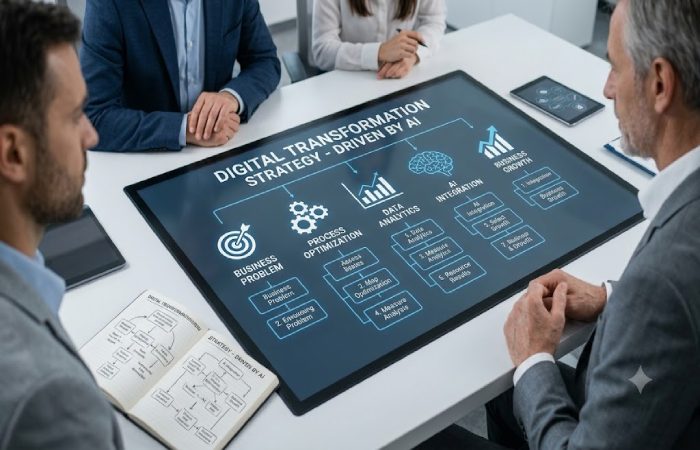
A Practical Digital Transformation Workflow
A useful transformation project normally starts with the business problem, not the technology name.
Workflow:
1. Identify the problem → 2. Map the current process → 3. Assess available data → 4. Select an appropriate technology → 5. Run a controlled pilot → 6. Measure results → 7. Improve and scale
For example, suppose an Indian e-commerce company spends significant staff time answering repetitive delivery questions.
Instead of immediately deploying a sophisticated AI system, the business could first examine the customer-support workflow, identify frequently repeated questions, check whether delivery data is reliable, and then test an AI assistant on a limited group of enquiries.
This approach makes performance measurable and reduces the risk of implementing technology simply because it is fashionable.
What Results Should Businesses Expect?
AI can improve efficiency, but organisations should avoid assuming that every AI project will automatically produce large savings.
A realistic evaluation should consider:
- Time saved per process
- Accuracy compared with existing methods
- Number of human interventions required
- Customer satisfaction
- Infrastructure and software costs
- Data quality
- Security and privacy requirements
- Employee training
- Maintenance requirements
A successful pilot may justify expansion, while an unsuccessful pilot can reveal that the underlying process needs improvement before more technology is added.
This is especially relevant for small and medium-sized businesses, where technology budgets and specialist resources may be limited.
Droven.io vs Typical Technology Platforms
| Factor | Droven.io | Typical AI software platform |
|---|---|---|
| Primary purpose | Information and education | Performing specific tasks |
| Main interaction | Reading articles and guides | Using software features |
| Dashboard | Not its primary public structure | Usually expected |
| AI implementation | Discusses AI concepts and tools | Provides an actual AI function |
| Pricing model | Not positioned primarily as SaaS | Often subscription or usage-based |
| Best use | Research and learning | Operational workflows |
| Due diligence needed | Verify individual claims | Evaluate security, pricing and performance |
This comparison helps avoid a common misunderstanding: reading about AI and using AI are two different activities.
Who Should Use Droven.io?
Droven.io may be useful for:
- Beginners learning technology terminology
- Business owners researching AI trends
- Students exploring emerging technologies
- Marketers interested in AI applications
- Technology professionals tracking industry topics
- Readers researching digital transformation concepts
It can serve as an initial research layer, particularly when someone needs a plain-language introduction before moving to official documentation or technical research.
For critical business decisions, however, readers should cross-check important claims with primary sources, vendor documentation, recognised standards and independent technical evidence.
Trustworthiness and Legitimacy: What Should You Check?
The existence of a professional-looking technology website does not automatically make every article authoritative.
When evaluating Droven.io or any similar technology publication, check:
- Author information – Is the author identifiable and suitably experienced?
- Publication date – Is the information recent enough for a rapidly changing technology?
- Primary sources – Does the article link to official documentation or research?
- Technical specificity – Does it explain how a claim was reached?
- Commercial bias – Is the article mainly designed to promote a product?
- Independent verification – Can important claims be confirmed elsewhere?
For AI-related decisions, governance is equally important. NIST’s AI Risk Management Framework recommends considering trustworthiness throughout the design, development, deployment, use and evaluation of AI systems.
A Sensible Way to Use Droven.io
Think of Droven.io as a starting point rather than the final authority.
A practical research process could look like this:
Discover a topic on Droven.io → understand the terminology → locate the original vendor or research source → verify technical claims → assess business relevance → test before scaling.
For example, an article about AI automation may introduce a useful concept. Before deploying the technology, a company should investigate its own data requirements, security implications, integration options, expected costs and measurable business outcomes.
This approach provides a better balance between curiosity and responsible technology adoption.
Key Benefits and Limitations
Benefits
- Broad coverage of modern technology
- Accessible explanations for non-specialists
- Useful exposure to AI and automation concepts
- Coverage of digital transformation themes
- Can help readers identify topics for deeper research
Limitations
- Editorial content is not a substitute for technical documentation
- Broad technology coverage means depth can vary by topic
- AI information can become outdated quickly
- Articles should not be treated as proof that a specific tool will work for every organisation
- Important security, compliance and financial decisions require additional verification
Common Use-Case Examples
A small business might use technology research to understand whether automated invoice processing is suitable.
A marketing team could investigate how generative AI affects content workflows.
An IT department might research cloud migration before reviewing specific infrastructure providers.
A larger enterprise could explore AI-assisted customer service while simultaneously assessing privacy, security, governance and integration requirements.
In each case, the content platform helps answer “What is this technology?” The organisation’s own testing and due diligence must answer “Should we use it?”
FAQ: Droven. io AI in Digital Transformation
What is droven. io AI in digital transformation?
Droven. io AI in digital transformation refers to Droven.io’s coverage of AI, automation, analytics, cloud technology and other subjects associated with modernising business processes. The website appears primarily to be an informational technology platform rather than a standalone AI application.
Is Droven.io an AI software product?
Current public information points more strongly towards an editorial and educational technology platform than a conventional AI SaaS product. It publishes information about AI tools and technologies but should not automatically be confused with the tools it discusses.
Can businesses use Droven.io for digital transformation?
Businesses can use its content as an educational research resource. Actual transformation projects require separate assessment of software, data, security, integration, costs and business outcomes.
Does AI guarantee successful digital transformation?
No. AI can support transformation, but successful implementation also depends on process design, data quality, employee adoption, governance, security and appropriate technology selection.
How should companies evaluate AI risks?
Companies should assess risks throughout the AI lifecycle rather than only after deployment. NIST’s AI RMF provides a voluntary framework covering trustworthy AI considerations and four core functions: Govern, Map, Measure and Manage.
Conclusion
Droven. io AI in digital transformation is best understood as a search topic connecting Droven.io’s technology content with the wider role of artificial intelligence in business modernisation. Droven.io presents itself as an editorial platform covering AI, emerging technology, automation, software development and digital transformation rather than as a clearly documented standalone AI product.
For readers, its strongest value is likely as an educational starting point. For businesses, the more important step comes afterwards: verify claims, examine primary sources, test technologies against real workflows and consider security and governance before scaling.
AI can be an important part of digital transformation, but it works best when it solves a clearly defined business problem rather than being adopted simply because it is new.