
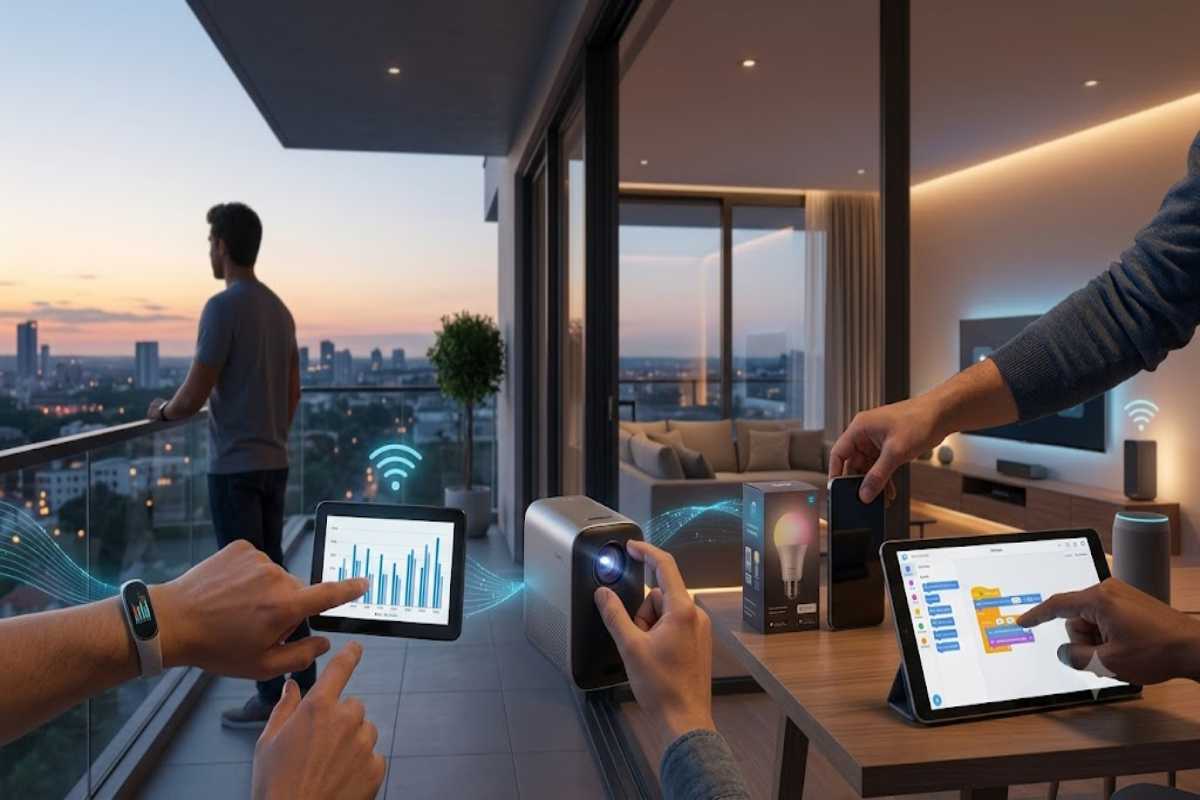
Droven.io new gadgets 2025 refers broadly to the new smart devices and consumer technologies covered in connection with Droven.io, including AI-powered devices, wearables, smart-home products, entertainment technology and connected gadgets. Droven.io is better understood as a technology information and review platform rather than a manufacturer selling a proprietary “Droven” gadget range.
What Does Droven.io New Gadgets 2025 Mean?
The first point worth clarifying is the meaning of the keyword itself.
Droven.io’s website presents technology news and reviews across areas including AI, IT, future technology, software and gadgets. Its technology categories specifically include “New Gadgets & Devices”, while its tech-review section includes gadget and device reviews.
That means droven.io new gadgets 2025 should not automatically be interpreted as a catalogue of gadgets manufactured by a company called Droven.
Instead, it is more useful to understand the phrase as a search for new and notable smart devices discussed through Droven.io’s technology coverage.
This distinction matters because several third-party pages present long lists of supposedly “Droven” products without establishing that they are actually manufactured, owned or officially sold by Droven.io.
For readers, the safer approach is to separate Droven.io’s editorial coverage from the individual manufacturers of the gadgets being discussed.
What Changed About Gadgets in 2025?
2025 was less about adding another specification and more about making existing devices smarter.
AI increasingly became part of consumer hardware, while connectivity between devices became more important. Droven.io’s own 2025 smart-device review highlights areas such as AI integration, automation, improved battery performance, stronger security and better integration with smart-home ecosystems.
| Gadget trend | What changed | Why it matters |
|---|---|---|
| AI-enabled devices | More on-device or cloud AI features | Automation and personalisation |
| Wearables | Better sensors and software | Health and activity tracking |
| Smart homes | More interconnected devices | Easier household automation |
| Smart TVs | AI-enhanced recommendations and processing | Better entertainment experience |
| Portable projectors | Smaller designs and improved connectivity | Flexible entertainment and presentations |
| Smart kitchen devices | More automation and programmable controls | Convenience and efficiency |
The important trend is therefore intelligence becoming a standard layer across different types of hardware.
AI Is Becoming the Common Thread

AI is arguably the biggest technology theme connecting many of the gadgets associated with 2025. A smart device used to mean little more than a product connected to Wi-Fi or controlled through an app. Increasingly, “smart” means that the device can interpret information, automate actions or personalise its behaviour.
For example, an AI-enabled home device may understand more natural voice commands. A wearable can analyse patterns in activity or sleep. A smart television can improve recommendations and picture processing.
But a consumer should not confuse the function of artificial intelligence with real intelligence; merely attaching a chatbot to existing interfaces may be no better than covertly performing a simple and monotonous task.
Wearables: More Data, Not Necessarily Better Decisions
Wearable technology remained one of the most visible gadget categories.
Smartwatches and fitness trackers increasingly combine activity tracking, sleep analysis, heart-rate measurements and other health-related metrics. Droven.io’s 2025 gadget review identifies wearable health devices as an important category within the smart-device landscape.
But there is an important limitation. More measurements do not automatically mean better health decisions.
Consumers should check:
- Whether the feature is available in their country
- Whether measurements are intended for general wellness or medical use
- How the device handles personal data
- Battery life under normal use
- Compatibility with their phone
- Whether useful features require a subscription
Especially important for health technology where language used for advertising can often sound more scientifically certain than the evidence available
Smart Homes Are Moving Towards Ecosystems
Another major development was the shift from individual smart products towards connected ecosystems.
A smart bulb is useful. A smart thermostat is useful. A smart security camera is useful. But their value can increase when they work together.
For example:
Sensor detects movement → automation activates lights → security system records activity → user receives an alert.
That is more meaningful than simply having four “smart” products.
Droven.io’s gadget coverage pays particular attention to smart home device integration, and so compatibility is one of the more important aspects when you shop for a new connected device.
Before buying, check whether the product works with the ecosystem already used in your home.
Security Should Be a Buying Criterion
Connected gadgets create convenience, but they also create additional digital endpoints.
A camera, speaker, television, smartwatch or smart appliance may collect information, connect to a network or communicate with cloud services.
That makes security part of the product specification.
Look for:
- Regular firmware updates
- Strong account authentication
- Encrypted communication
- Clear privacy policies
- Support from an established manufacturer
- The ability to remove or delete stored data
A cheap gadget with weak long-term software support may ultimately be a worse investment than a more expensive product from an established ecosystem.
How to Evaluate a 2025 Gadget Before Buying
Rather than choosing a gadget because it appears in a “best gadgets” list, use a simple evaluation framework.
| Factor | Question to ask |
|---|---|
| Usefulness | Does it solve a real problem? |
| Compatibility | Will it work with my existing devices? |
| Software | Will updates continue? |
| Privacy | What information does it collect? |
| Battery | How long does it realistically last? |
| Durability | Can it survive normal daily use? |
| Warranty | What happens if it fails? |
| Total cost | Are subscriptions or accessories required? |
This approach is particularly valuable for beginners because specifications can be misleading.
A device with a faster processor, higher-resolution display or more AI features is not automatically the better purchase.
Which Gadgets Were Most Interesting?
From a practical perspective, the strongest 2025 categories were those where technology solved an existing problem rather than creating another app or dashboard.
1. AI-Powered Personal Devices
AI features became increasingly integrated into smartphones, computers, wearables and other personal technology.
The biggest potential benefit is reduced friction: summarising information, improving search, automating repetitive actions or making interfaces easier to use.
2. Smart-Home Technology
Connected home devices are increasingly valuable when they work together rather than operating independently.
Compatibility should therefore be considered before buying individual products.
3. Wearables
Wearables continue to appeal because they provide information continuously rather than requiring users to manually check an app.
Their usefulness depends heavily on accuracy, battery life and whether the collected information actually changes behaviour.
4. Portable Entertainment Devices
Portable projectors and connected entertainment devices became attractive for travellers, remote workers and consumers wanting flexible viewing options. Droven.io’s 2025 review identifies portable smart projectors as one of the notable smart-device categories.
Is Droven.io a Gadget Manufacturer?
Based on the publicly available Droven.io pages reviewed for this article, it is more accurate to describe Droven.io as a technology publishing and information platform than as a manufacturer with a proprietary gadget catalogue.
Its own categories cover technology news, AI, future technology and new gadgets, while its 2025 review discusses products and categories across the wider consumer technology market.
That distinction is important for anyone researching droven.io new gadgets 2025. If an article claims that a particular smartwatch, television or smart-home product is an official “Droven” product, verify the claim against an official manufacturer page before treating it as fact.
Frequently Asked Questions
What are Droven.io new gadgets 2025?
They refer broadly to new smart devices and gadget technology covered in relation to Droven.io’s technology content. The topic includes AI devices, wearables, smart-home technology and connected consumer electronics.
Does Droven.io manufacture its own gadgets?
Droven.io’s available website material supports viewing it primarily as a technology content and review platform rather than a conventional hardware manufacturer. Its gadget content discusses broader smart-device categories.
What should I check before buying a smart gadget?
Check compatibility, software-update support, privacy, security, battery life, warranty, durability and the total cost of ownership.
Are AI gadgets automatically better?
No. AI can improve automation and convenience, but an AI feature is valuable only when it provides a useful improvement over a simpler alternative.
Are smart-home gadgets worth buying?
They can be, particularly when devices work within a compatible ecosystem and solve practical problems such as automation, security, energy management or convenience.
Final Verdict
The most useful way to understand droven.io new gadgets 2025 is as a technology-content topic rather than a proprietary product catalogue. The bigger story behind the keyword is the evolution of consumer technology towards AI-assisted functionality, connected ecosystems, automation and more personalised experiences. Droven.io’s own 2025 gadget coverage reflects these themes, particularly across smart homes, wearables, entertainment technology and connected devices.
But the smartest buying decision is not necessarily the gadget with the longest feature list. Look for technology that is useful, compatible, secure, supportable and reasonably priced. That approach will remain relevant long after the 2025 product cycle has ended.