
A player opens a treasure chest in a video game. A digital card game shuffles its deck. A virtual die rolls across the screen and stops on a number.
Each event needs an outcome that players cannot predict with ease.
Behind these results sits a key piece of software: the random number generator (RNG).
An RNG produces values that games use to select items, shuffle cards, create maps, and decide the results of chance-based events.
Without this technology, many games would feel fixed. Players could learn the order of every card or predict where each item would appear.
Yet computers follow instructions. They do not make random choices in the same way that a person might draw a numbered ball from a bag.
To solve this problem, developers use mathematical algorithms and, in some cases, data from physical sources of randomness.
These systems help games create varied outcomes while following clear rules.
The technology also raises important questions. How can software produce results that appear random? How do developers test those results? And what stops someone from predicting or changing them?
Understanding RNG technology reveals how modern games combine mathematics, software design, and security to manage chance.
How Random Number Generators Work In Digital Games
A random number generator (RNG) gives software a way to select outcomes without using a fixed sequence that players can easily recognize.
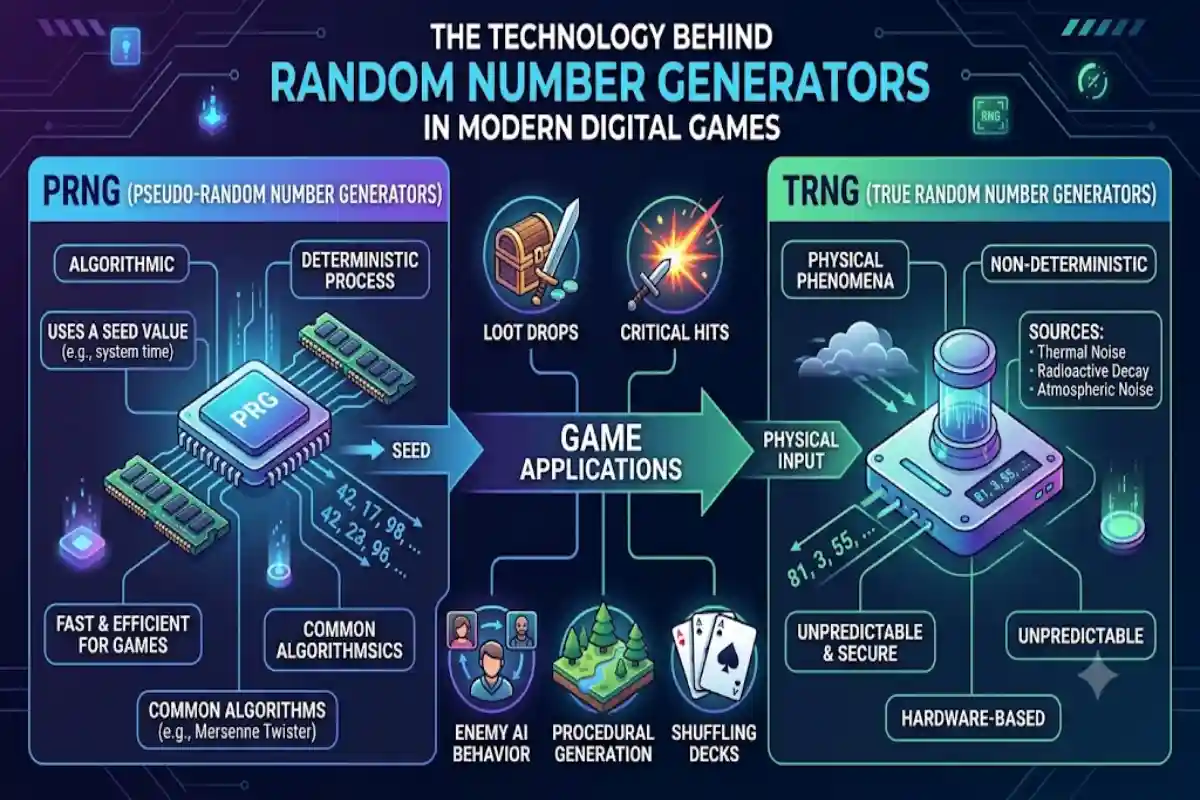
Most digital games use a pseudorandom number generator (PRNG). This system starts with a value called a seed. It then applies a mathematical rule to produce a series of numbers.
The results may look random, but the process follows exact instructions. If a developer uses the same seed and algorithm, the generator produces the same sequence again.
This feature helps teams test games and reproduce errors.
Imagine a digital card game. The RNG creates numbers that the software uses to shuffle a deck. The game then displays the cards in their new order.
The same principle applies to virtual dice, random maps, and item drops.
RNG technology also appears in casino-style software. For example, a technical review of a desi play online casino system might examine how its software generates outcomes and whether independent tests support its claims of randomness.
Randomness does not guarantee equal chances for every possible reward. Developers can assign different probabilities to different outcomes.
The key distinction is between a random selection process and the rules that determine which results are possible.
Together, these elements shape how chance works inside a digital game.
The Difference Between True And Pseudorandom Numbers
Not all random numbers come from the same source. Developers use two main methods, each with its own strengths.
Pseudorandom number generators (PRNGs) use math to create a sequence of values. A seed sets the starting point, and an algorithm produces each new number.
PRNGs work fast and use little computing power. This makes them useful for video games that need many random values each second.
However, a PRNG is not truly random. Someone who knows its seed and algorithm can reproduce its output.
True random number generators (TRNGs) take data from physical events, such as electronic noise. These events provide a source of uncertainty that does not come from a fixed formula.
TRNGs often need special hardware and may produce data more slowly than software-based systems.
Some systems combine both methods. They gather random data from physical sources and use it to seed a secure software generator.
The right method depends on the task. A game map may only need fast, varied results. A security system needs numbers that attackers cannot predict.
Understanding this difference helps explain why one type of RNG cannot meet every software need.
How Developers Test Random Number Generators
A random number generator must do more than produce numbers that look mixed. Developers need to check whether its output follows the expected rules.
Statistical testing helps reveal patterns that should not appear in a well-designed generator.
For example, imagine a digital die with six equally likely outcomes. After thousands of rolls, each number should appear close to one-sixth of the time.
The counts will not match exactly. Small differences are normal in random data.
Developers also test whether one result affects the next. If a generator produces the same short pattern again and again, it may have a flaw.
Common tests examine frequency, distribution, and correlation. These checks help teams find errors in the generator or the way software uses its output.
However, passing statistical tests does not prove that a generator is secure. A predictable algorithm can still produce numbers that look random.
Security tests must also examine how the system creates and protects its seed.
Reliable RNG testing combines mathematical checks with careful software review. Both help developers detect faults before those faults affect a game.
Why RNG Security Matters In Online Games
An RNG may produce results that look random yet remain easy to predict. This can create serious problems in online games.
If someone learns the seed of a weak generator, they may be able to work out its next values. That could expose hidden game events or weaken security features.
Cryptographically secure random number generators (CSPRNGs) help reduce this risk. They use methods designed to make future outputs hard to predict, even when an attacker knows some past results.
Developers also need to protect the systems around the generator.
For example, a secure RNG offers little protection if the game sends hidden outcomes to players before it should. Poor access controls can also let unauthorized users change game data.
Server-side validation helps keep important decisions under the platform’s control. The server checks game actions instead of trusting every value sent by a player’s device.
Teams must also guard seeds, review code, and fix known flaws.
The main lesson is clear: randomness and security are different requirements. A game needs both sound number generation and strong software controls to protect its results.
Why Reliable Randomness Matters In Modern Games
Random number generators help digital games create varied and unpredictable events. They shuffle cards, shape virtual worlds, and select outcomes based on rules set by developers.
PRNGs offer speed and repeatable results, which makes them useful for game design and testing. Physical sources of randomness provide another way to create unpredictable data. Secure generators help protect systems where prediction could cause harm.
Yet no single method solves every problem.
Developers must also test number distributions, protect seeds, and check how their software uses each result. A sound generator cannot fix weak game rules or poor security.
Reliable randomness depends on the entire system, not just one algorithm.
As digital games grow more complex, RNG technology will remain an essential part of their design. Understanding how it works helps explain the balance between chance, mathematics, and the code that controls what appears on screen.