
Ask three IT vendors what is included in their service and you will get three answers, two vague nods toward “full coverage,” and one PDF so dense it reads like a phone contract from 2009. I have sat through enough of these pitches to notice a pattern: the less specific the language, the more expensive the surprise waiting in month four. “Comprehensive support” and “complete peace of mind” are not line items. They are the sound a sales deck makes when it does not want you asking what happens when your server actually goes down at 6pm on a Friday.
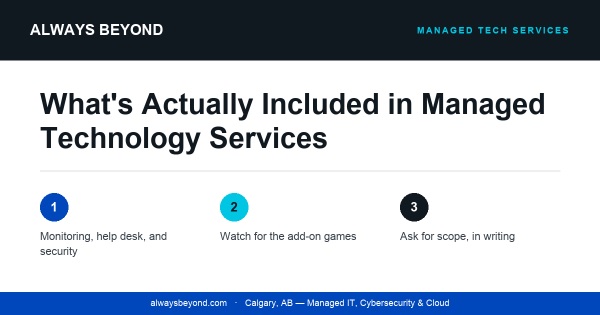
So let’s do the unglamorous work of actually defining managed technology services, the way a consumer advocate would define the fine print on a phone plan, because that is essentially what this is: a subscription with a lot riding on what counts as “included” versus what quietly becomes a change order. At its core, a real managed offering covers four things: someone monitoring your systems so problems get caught before they become outages, a help desk that actually picks up (ask about response time, not just availability), security work that goes beyond a firewall sticker on the wall, and cloud environment management, meaning your Microsoft 365 or Google Workspace setup is actually configured correctly, not just switched on and left alone.
Here is where it gets interesting, because the add-on games vendors play are fairly predictable once you know to look for them. Watch for these patterns:
| What sounds included | What often turns out to be extra |
| “24/7 monitoring” | Actual after-hours response by a live technician |
| “Security included” | Incident response after an actual breach |
| “Cloud support” | Migrating you off legacy software, or third-party app integrations |
| “Unlimited help desk” | On-site visits, hardware procurement, or new employee onboarding |
None of this is necessarily dishonest. Monitoring genuinely is different from response, and it is fair for a vendor to price them separately. The problem is when the marketing language implies bundling that the contract does not deliver, and you find out during an actual crisis rather than during the sales call, which is the worst possible moment to be renegotiating scope.
The other trick worth naming is the tiered pricing structure designed to make the cheapest tier look tempting and the middle tier look “reasonable” by comparison, a trick lifted straight from the streaming service and gym membership playbook. It works because most buyers do not know what they need until they need it, so they anchor on price instead of coverage. A flatter model, one all-inclusive package with no tiers, no hidden fees, and no long-term contract locking you in, removes that guessing game entirely. You either get full coverage or you do not, and you can tell which one you are getting before you sign anything.
Security deserves one more honest note, because vendors oversell it constantly. No responsible provider should claim that a single tool or setting is universally applied and therefore your business is unhackable. What a decent provider actually does is help set up strong multi-factor authentication, patch known vulnerabilities on a schedule, and align practices with recognized frameworks like CIS Controls, which is a meaningfully different, more honest claim than “we protect you from everything.”
There is a similar shell game around response time. “Fast support” means nothing without a number attached to it. Does the phone actually get answered by a human being, or does it route to a ticketing form that gets triaged sometime tomorrow? A sub-90-second phone response is a specific, checkable claim, and specific claims are what you should demand from anyone pitching a support contract, instead of accepting adjectives as evidence. If a vendor cannot tell you their average hold time, that silence is itself useful information.
If you take one thing from this: before you sign anything, ask your prospective provider to define, in writing, what happens the moment something breaks at an inconvenient hour. Not what they monitor. Not what they are capable of. What they actually do, and how fast. Full-service IT company Always Beyond takes that approach in Calgary, treating monitoring, security, cloud management, and help desk support as one package rather than a menu of upsells, which is honestly how this should have worked from the start.
The rest is just vocabulary. Learn to read it before you buy it.